You’ve probably heard the term “RAG” thrown around in conversations about AI chatbots. But what does it actually mean, and why should it matter to your business? If you’re considering deploying an AI chatbot — or wondering why some chatbots are vastly smarter than others — this guide breaks it all down.
What is RAG?
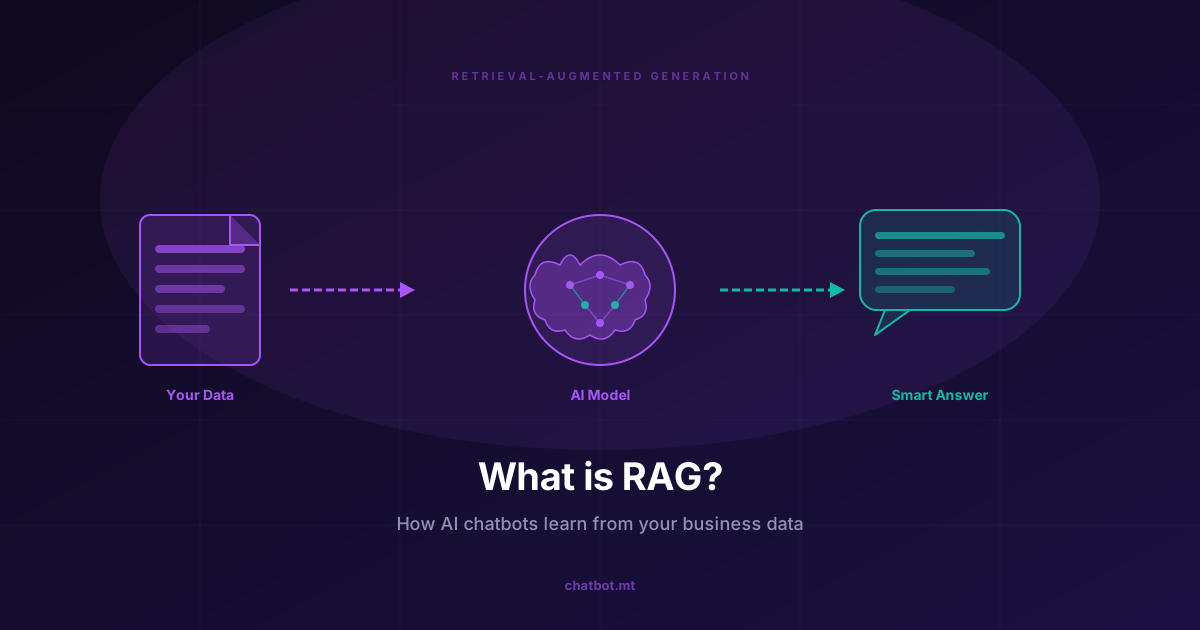
RAG stands for Retrieval-Augmented Generation. It’s a technique that combines two powerful components of modern AI:
- Retrieval — the ability to search and pull relevant information from a knowledge base (your documents, FAQs, website content, product data, etc.)
- Generation — the ability of a large language model (LLM) to produce fluent, natural language responses
In simple terms, RAG gives an AI chatbot a memory — your memory. Instead of relying solely on what the model learned during training, a RAG-powered chatbot first searches your data sources, finds the most relevant pieces of information, and then crafts a response grounded in that specific context.
Why Standard LLMs Fall Short
Standard large language models like GPT-4 or Gemini are trained on vast amounts of internet text. They’re impressively capable, but they have two significant limitations for business use:
- Knowledge cutoff: Their training data has a cutoff date. They don’t know what happened last week, let alone what your business’s current pricing or policy is.
- No knowledge of your business: A base LLM has never read your product manuals, your support documentation, or your company-specific FAQs.
This is why a generic AI chatbot will often give vague, outdated, or simply wrong answers when customers ask specific questions about your business. RAG solves both of these problems.
How RAG Works: A Step-by-Step Breakdown
Here’s what happens under the hood when a customer sends a message to a RAG-powered chatbot:
Step 1: The Query Arrives
A user types something like: “What are your shipping times to Gozo?”
Step 2: Semantic Search
The system converts that question into a mathematical representation (called an embedding) and searches your knowledge base for the most semantically similar content — not just keyword matches, but meaning-based matches. It might find a paragraph in your shipping policy document.
Step 3: Context Retrieval
The most relevant chunks of text from your knowledge base are retrieved and passed to the language model as context.
Step 4: Grounded Generation
The LLM now generates a response, but crucially, it’s grounded in the retrieved content. It can synthesise, paraphrase, and communicate naturally — while staying anchored to the facts you’ve provided.
Step 5: Accurate Answer
The user receives a specific, accurate, helpful answer: “We ship to Gozo within 2-3 business days. Orders placed before 2pm are dispatched same day.”
RAG vs Fine-Tuning: What’s the Difference?
A common alternative to RAG is fine-tuning — retraining a model on your data so it “bakes in” your information. While fine-tuning has its uses, RAG has several practical advantages for most businesses:
| Approach | Update Cost | Freshness | Transparency |
|---|---|---|---|
| Fine-tuning | High (requires retraining) | Low (static after training) | Low (hard to audit) |
| RAG | Low (update your documents) | High (real-time retrieval) | High (sources traceable) |
With RAG, when your policies change or you launch a new product, you simply update your knowledge base. The chatbot immediately knows the new information. No retraining required.
Real-World Business Benefits of RAG
Accuracy You Can Trust
Because responses are grounded in your actual documents, hallucination — the tendency for AI to confidently make things up — is dramatically reduced. Your chatbot says what your business says.
Always Up to Date
Add a new FAQ? Update your pricing page? Change your return policy? Your RAG-powered chatbot picks it up immediately. There’s no lag between your real-world knowledge and what the bot tells customers.
Traceable Answers
With RAG, you can often see which document or data source informed an answer. This is invaluable for regulated industries like finance or healthcare where auditability matters.
Multi-Source Knowledge
A RAG system can pull from multiple sources simultaneously — your website, your PDFs, your product catalogue, your support tickets — and synthesise a coherent answer that draws on all of them.
RAG in Practice: Industries That Benefit Most
RAG-powered chatbots are particularly valuable in knowledge-intensive sectors:
- Finance: Answering questions about products, rates, and compliance from official documentation — see how AI chatbots for finance work in practice.
- Healthcare: Providing accurate information about services, appointment procedures, and health guidelines grounded in verified content.
- E-commerce: Drawing on live product catalogues, shipping policies, and return procedures to answer customer queries accurately.
- Legal: Enabling firms to surface relevant clauses and procedures from their document libraries without manual searching.
How chatbot.mt Uses RAG
At chatbot.mt, every chatbot we build is powered by RAG. When you connect your data sources — your website content, uploaded documents, FAQs, or product catalogues — we convert that content into a searchable knowledge base. Every customer query is handled by combining intelligent retrieval with powerful generation.
The result: a chatbot that genuinely knows your business, answers accurately, and updates automatically when your information changes.
Getting Started
If you’re ready to deploy a chatbot that actually understands your business, RAG is the technology that makes it possible. You don’t need to understand the technical plumbing — you just need to provide your content, and the system handles the rest.
Explore our features page to see how easy it is to connect your data, or check our pricing to find the plan that fits your needs.
Want to go deeper? Read our guide on how to train your AI chatbot with your own data or learn about building a customer support chatbot in 5 minutes.