When businesses first explore AI chatbots, ChatGPT is usually the first thing that comes up. It’s impressive, it’s well-known, and it’s free to try. But there’s a significant gap between “ChatGPT is useful” and “ChatGPT can run our customer support”. Understanding that gap will save you time, money, and customer frustration.
Here’s an honest comparison.
What ChatGPT Actually Is
ChatGPT is a general-purpose AI assistant built by OpenAI. It’s trained on vast amounts of internet text and can produce impressive outputs across an enormous range of tasks — writing, coding, analysis, brainstorming, translation.
What it isn’t: a customer support agent for your specific business.
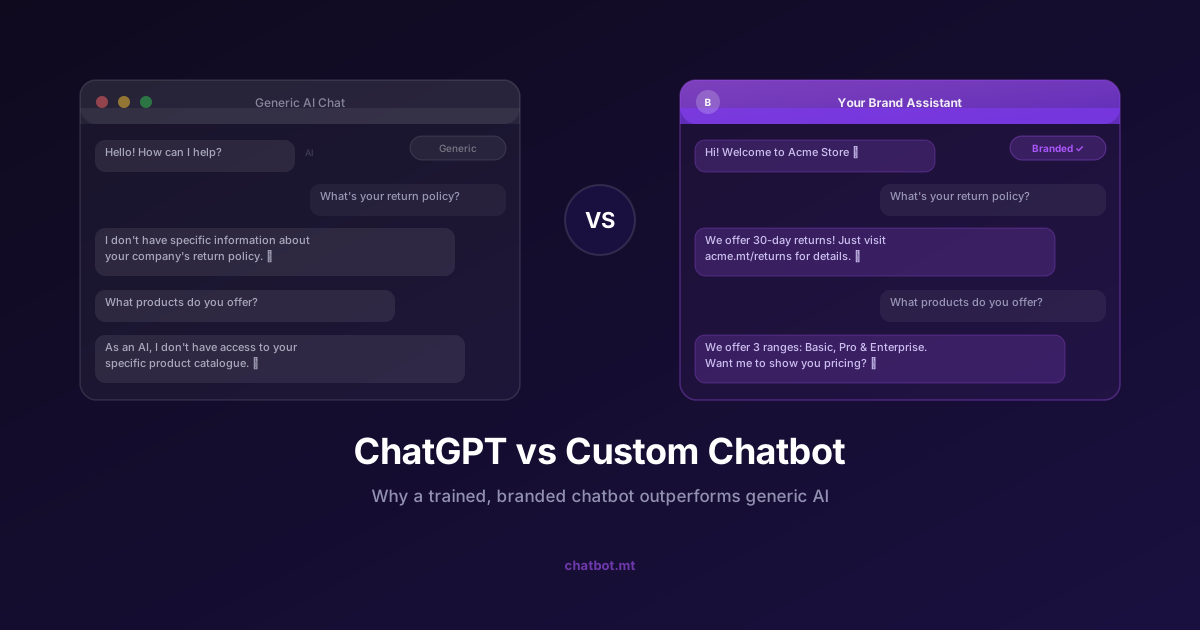
ChatGPT doesn’t know your pricing. It doesn’t know your return policy. It doesn’t know what products you have in stock, what your opening hours are, or how your booking process works. When a customer asks these questions, it either makes something up (confidently wrong), says it doesn’t know, or gives generic information that may not apply to you at all.
That’s not a failure of ChatGPT — it’s simply not what it was designed for. It’s a general-purpose tool being asked to do a specific job.
What a Custom AI Chatbot Is
A custom AI chatbot is purpose-built for a specific business use case. Rather than relying solely on what an AI model learned during training, it uses Retrieval-Augmented Generation (RAG) to ground every response in your actual business content — your FAQs, product catalogue, policies, website copy, and documentation.
The underlying model is still powerful — often using the same GPT or Gemini models under the hood — but it’s constrained to your knowledge and configured for your workflow. The result is a chatbot that:
- Knows your specific products, services, and pricing
- Follows your brand voice and communication guidelines
- Integrates with your systems (CRM, booking tools, order management)
- Escalates to your human team when appropriate
- Works within your channels (website, WhatsApp, Messenger)
- Can be updated instantly when your information changes
Head-to-Head: ChatGPT vs Custom AI Chatbot
Business Knowledge
ChatGPT: General knowledge only. Will not know your specific business information, and may confidently provide incorrect information if pushed on specifics.
Custom Chatbot: Trained on your content. Knows exactly what you’ve told it — your prices, your policies, your products, your procedures.
Accuracy for Business Queries
ChatGPT: High risk of hallucination on specific business facts. Excellent for general topics.
Custom Chatbot: High accuracy for queries within its knowledge base. Designed to say “I don’t know” or escalate rather than guess.
Brand and Persona
ChatGPT: It’s always ChatGPT. You can’t give it your brand name, your tone, or your persona.
Custom Chatbot: Fully customisable. It can be “Alex from [Your Business]”, speak in your brand voice, and be introduced as your own AI assistant.
Channel Integration
ChatGPT: Available via openai.com and through API. Not embedded into your website or WhatsApp natively.
Custom Chatbot: Deployed directly on your website, WhatsApp, Facebook Messenger, Instagram, Telegram, and Slack.
Human Handoff
ChatGPT: None. There’s no mechanism to pass a conversation to your support team.
Custom Chatbot: Configurable handoff triggers that route conversations to your agents with full context.
CRM and System Integration
ChatGPT: None natively (though developers can build custom integrations via API).
Custom Chatbot: Native integrations with popular CRMs, helpdesks, booking systems, and e-commerce platforms.
Conversation History and Analytics
ChatGPT: Limited analytics. Conversations happen on OpenAI’s platform.
Custom Chatbot: Full dashboard with conversation history, resolution rates, escalation rates, popular queries, and performance trends.
Data Privacy
ChatGPT: Customer conversations go to OpenAI. For businesses in regulated industries — finance, healthcare, legal — this may raise compliance concerns.
Custom Chatbot: Data governance is in your control. Choose where data is stored and processed.
Cost Structure
ChatGPT: Free or flat monthly subscription for consumer use. API pricing for developers building custom integrations (which requires technical resources).
Custom Chatbot: Monthly subscription that includes the platform, knowledge base management, integrations, and support — no development cost.
But Can’t I Just Use the ChatGPT API?
Technically, yes. Developers can access the ChatGPT API and build a custom application on top of it. But this approach:
- Requires development resources (and ongoing maintenance)
- Still doesn’t handle the knowledge base, RAG, channel integrations, analytics, or human handoff out of the box
- Takes weeks or months to build properly
- Creates an ongoing technical dependency
A purpose-built chatbot platform like chatbot.mt gives you all of this without writing a line of code, in under an hour. The API path makes sense for companies with specific, unusual requirements and a dedicated engineering team. For most businesses, it’s not the right starting point.
When Might You Use ChatGPT Instead?
There are genuine use cases where ChatGPT (or similar general AI tools) are the right choice for businesses:
- Internal productivity: Drafting emails, summarising documents, generating content, brainstorming
- Ad-hoc research: Exploring topics, generating options, analysing text
- Developer tasks: Code review, debugging, technical documentation
These are tasks with open-ended, general-purpose requirements. Customer support is not one of them.
The Hybrid Reality
Worth noting: the best custom chatbots use powerful models like GPT-4 or Gemini under the hood — they just constrain and guide those models with your specific business knowledge and workflow logic. You get the reasoning power of the world’s best language models applied precisely to your use case.
It’s not ChatGPT vs AI chatbots. It’s raw AI vs purpose-built AI. For customer support, there’s a clear winner.
Conclusion
ChatGPT is a remarkable general-purpose tool. For answering customer questions about your specific business, 24/7, on your website and WhatsApp, with human handoff and CRM integration — you need a custom AI chatbot.
Explore our features page to see what a purpose-built chatbot looks like, or start with our quick-launch guide to understand how fast you can go from zero to live.
Related reading: What is RAG? How Retrieval-Augmented Generation Powers Smarter Chatbots and AI Chatbots vs Live Chat: Which is Right for Your Business?