
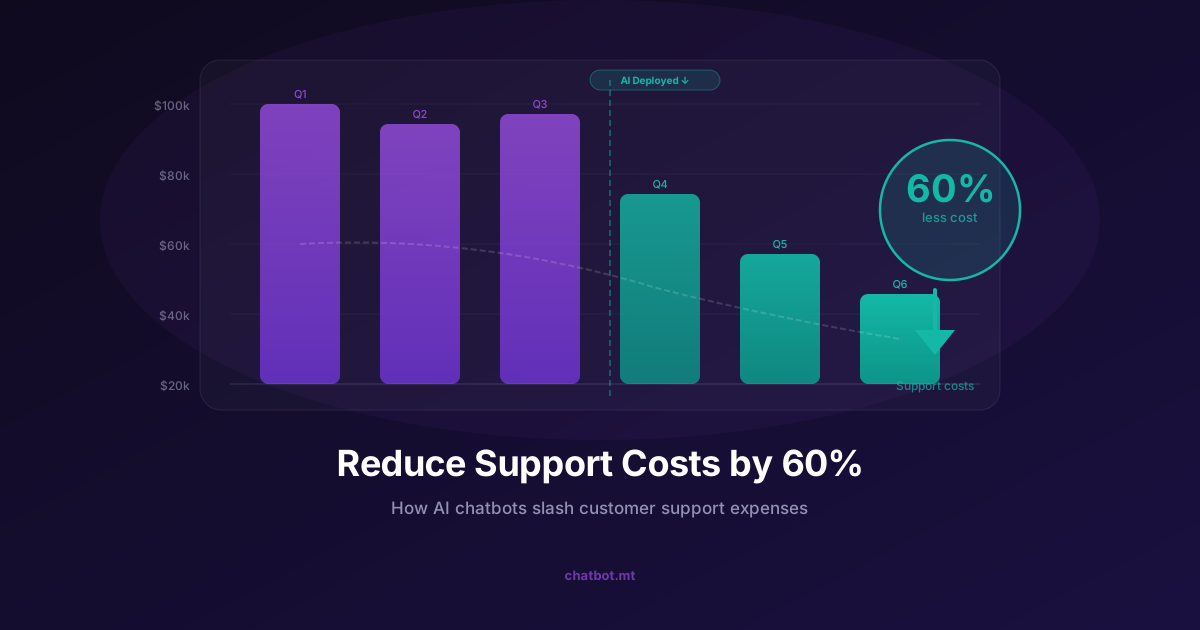
The 60% figure gets cited often enough that it’s tempting to dismiss it as marketing hyperbole. It isn’t. Multiple independent studies — from Gartner, IBM, and Juniper Research — consistently find that businesses deploying well-configured AI chatbots reduce their customer support costs by 30–70%. The range is wide because results depend heavily on implementation quality, use case fit, and baseline support complexity.
This article breaks down exactly where those savings come from, how to calculate your own potential ROI, and what separates the businesses that hit 60% from those that fall short.
Where the Costs Actually Come From in Customer Support
To understand where chatbots save money, you need to understand where the money goes.
A typical customer support operation has costs across five categories:
- Agent salaries and benefits — typically 60–70% of total support costs
- Training and onboarding — significant ongoing cost in high-turnover environments
- Management and quality assurance — supervisors, QA reviewers, team leads
- Infrastructure — phone systems, helpdesk software, office space
- Missed enquiries and churn — the hidden cost of customers who couldn’t get help and left
AI chatbots attack costs in the first, second, and fifth categories most directly.
The Primary Cost Driver: Deflection Rate
The most important metric in chatbot ROI is deflection rate — the percentage of customer enquiries that the chatbot resolves without any human agent involvement.
An average, well-implemented chatbot achieves 60–70% deflection on typical SME support queues. For businesses with highly repetitive query patterns (e-commerce, hospitality, utilities), deflection rates of 80%+ are achievable.
Here’s what that means in numbers:
Example: 500 enquiries per month
- Agent cost per handled enquiry: €8 (factoring salary, overhead, training amortisation)
- Total agent cost at 500 enquiries: €4,000/month
- Chatbot deflection rate: 65%
- Enquiries handled by chatbot: 325
- Enquiries remaining for agents: 175
- New agent cost: €1,400/month
- Chatbot subscription: €200/month
- Total new cost: €1,600/month
- Saving: €2,400/month (60%)
The maths scales. At 1,000 enquiries per month with similar rates, the saving approaches €5,000/month. At 2,000 enquiries, you’re looking at savings that more than justify a dedicated chatbot implementation team.
Cost Driver 2: First Contact Resolution
Beyond deflection, AI chatbots improve first contact resolution (FCR) — the rate at which customer queries are fully resolved in a single interaction without follow-up.
Human agents answering the same question repeatedly introduce variability. They may give incomplete answers, create follow-up tickets, or escalate unnecessarily. A well-configured chatbot, grounded in your actual knowledge base through RAG technology, gives the same complete, accurate answer every time.
Higher FCR means fewer repeat contacts for the same issue, reducing total volume and agent load. Research suggests AI chatbots achieve FCR rates 15–20% higher than human agents for routine query types.
Cost Driver 3: Handling Time
Even for enquiries that do reach a human agent, chatbot-assisted support reduces average handling time. When a chatbot has already:
- Collected customer details and account information
- Identified the nature of the enquiry
- Retrieved relevant order or account data
- Provided initial troubleshooting steps
…the agent walks into a conversation that’s already partially resolved. They spend time solving the problem, not gathering context.
Studies show agent handling time drops by 20–40% with effective chatbot pre-qualification, further compressing the cost per resolved ticket.
Cost Driver 4: Overnight and Weekend Coverage
Running a 24/7 support operation with human agents is expensive. Night shifts attract pay premiums, weekend rates add cost, and the queues that build overnight generate customer dissatisfaction and churn.
A chatbot handles overnight and weekend enquiries at zero incremental cost. For businesses that previously missed after-hours queries — e-commerce stores, restaurants, hospitality businesses — the chatbot doesn’t just reduce costs; it recovers revenue that was previously being lost.
Cost Driver 5: Training and Onboarding
Customer support has notoriously high turnover. Every time you hire a new agent, you invest weeks of training before they’re productive. Then they leave, and you start again.
A chatbot never leaves. It doesn’t need onboarding. When your policies change, you update the knowledge base once, and the chatbot immediately reflects the new information across every conversation. Train your chatbot with your own data and it never needs retraining as new agents do.
This is a significant but often uncounted saving — particularly for SMEs where a single departure disrupts the whole team.
Calculating Your Own ROI
Use this framework to estimate your potential savings:
Step 1: Establish your current cost per enquiry
Total monthly support cost ÷ Total monthly enquiries = Cost per enquiry
Include salaries, benefits, software, management overhead, and a proportion of office costs.
Step 2: Estimate your deflection rate
For businesses with:
- High-repetition, simple queries (e-commerce, hospitality, utilities): estimate 70–80% deflection
- Mixed simple and moderate queries (retail, professional services): estimate 55–70% deflection
- High complexity, custom queries (legal, high-value B2B): estimate 30–50% deflection
Step 3: Calculate the saving
(Monthly enquiries × Deflection rate × Cost per enquiry) − Chatbot subscription cost = Monthly net saving
Step 4: Add the indirect savings
- After-hours leads recovered × Average lead value
- Reduced churn from faster response times
- Agent productivity improvement from reduced volume
Most businesses find their payback period is measured in weeks, not months.
What Separates High-ROI Implementations from Low-ROI Ones
Not every chatbot deployment hits 60% savings. Here’s what makes the difference:
Knowledge base quality: A chatbot trained on comprehensive, accurate content achieves far higher deflection than one with sparse or outdated information. Invest time in building a thorough knowledge base at setup.
Proper scope definition: Chatbots excel at defined, repetitive query categories. Trying to make a chatbot handle everything — including highly complex, nuanced queries — reduces overall effectiveness. Define what the chatbot handles and what escalates to humans.
Continuous optimisation: The best implementations review conversation logs weekly and continuously add missing content and refine responses. Chatbots that are set and forgotten underperform.
Effective human handoff: If customers can’t easily reach a human when they need one, satisfaction drops and re-contact rates rise. Seamless handoff preserves both the cost saving and the customer relationship.
Industry Benchmarks
The finance sector sees some of the strongest ROI given the high volume of routine enquiries (account queries, product information, policy questions) combined with the high cost of regulated, trained human agents.
Telecommunications companies have been among the most aggressive chatbot adopters, with some reporting 80%+ deflection rates for billing and service queries.
Insurance companies use chatbots to handle initial claims queries, policy information, and renewal processes — reducing cost per interaction significantly.
Next Steps
The evidence is clear: a well-implemented AI chatbot is one of the most cost-effective investments a business can make in its support operations. The key word is “well-implemented” — which is why platform choice and setup quality matter.
Check our pricing page to understand what a chatbot investment looks like for your business size, and read our 5-minute setup guide to understand how quickly you can get started.
Related reading: AI Chatbots vs Live Chat: Which is Right for Your Business? and 10 Ways AI Chatbots Improve Customer Experience